28–30 April 2026
In support of Papua New Guinea’s (PNG) Medium Term Development Plan (MTDP) V 2027–2032 preparation process, the International Food Policy Research Institute (IFPRI), in collaboration with PNG’s Department of National Planning and Monitoring (DNPM), conducted a series of trainings between 28 April and 8 May 2026 aimed at strengthening government capability in economic data analysis and Computable General Equilibrium (CGE) modelling.
The trainings form part of IFPRI-PNG’s broader commitment to strengthening evidence-based planning and policy analysis in PNG by building technical and analytical capacity across key government agencies and sector institutions. Through practical and hands-on sessions, participants were introduced to data management, economic analysis, Social Accounting Matrix (SAM) development, and CGE modelling techniques used to support economic planning and policy assessment.
The three-day pilot training focused on data collation, cleaning, validation, analysis, and interpretation to strengthen evidence-based planning and economic analysis within the agriculture sector. A total of nineteen participants attended the workshop, representing DNPM and key agricultural institutions, including the Department of Agriculture and Livestock (DAL), the Cocoa Board of PNG (CBPNG), the Kokonas Indastri Koporesen (KIK), the Rubber Industry Development Board (RIDB), and the Coffee Industry Corporation (CIC).
The opening and closing sessions were attended by Michael Kumung, Deputy Secretary responsible for Policy and Planning at DNPM, and Sanja Papae, First Assistant Secretary (FAS) overseeing the Macro Planning Division at DNPM.
In welcoming participants, Kwaw Andam, IFPRI-PNG Country Program Leader, acknowledged the critical role of quality data in supporting accurate policy analysis and informed decision-making in PNG. He emphasised that the pilot training was designed to be highly practical and focused on the tools, datasets, and analytical approaches currently being used by DNPM and IFPRI-PNG. He noted that the training would contribute towards improving the availability, quality, and reliability of data used for economic analysis and CGE modelling.
Deputy Secretary Kumung underscored the importance of credible and reliable economic data for national planning and policy analysis. He highlighted that quality data is essential for assessing how government investments and policy interventions translate into economic growth, development outcomes, and improvements in key macroeconomic indicators. He further encouraged government officers across sectors to take greater ownership of data collection, validation, and management processes to support effective planning and evidence-based decision-making.
FAS Sanja Papae highlighted the importance of the pilot training as a foundation for future CGE modelling and analytical training programs to be conducted by IFPRI and DNPM throughout the year. He emphasised the link between sector-level planning initiatives and broader national development frameworks, including MTDP IV, the Development Strategic Plan (DSP) 2010–2030, and Vision 2050.
During the training, the lead facilitator, Barun Deb Pal, introduced participants to key national and international data sources, including PNG Gross Domestic Product data, the World Integrated Trade Solution (WITS), and the Food and Agriculture Organization of the United Nations (FAO) and FAOSTAT databases. Participants were guided on how to access, search, and extract data from credible sources for economic and policy analysis.
Participants also received practical training in Microsoft Excel on organising, collating, and analysing economic data. Sessions covered the calculation and interpretation of nominal and real growth rates, annual growth rates, and their application in Gross Domestic Product (GDP) analysis and economic planning.
As part of the practical exercises and group presentations, participants selected agricultural subsectors and calculated the growth rates required to achieve targets outlined in the Medium Term Development Plan IV (MTDP IV). Through these exercises, participants identified data discrepancies across sectors and assessed the feasibility of growth targets outlined in MTDP IV. Discussions also focused on how sector agencies could contribute policy recommendations to address data gaps, strengthen sector planning, and support preparations for MTDP V.
Picture by IFPRI-PNG: Pilot Training
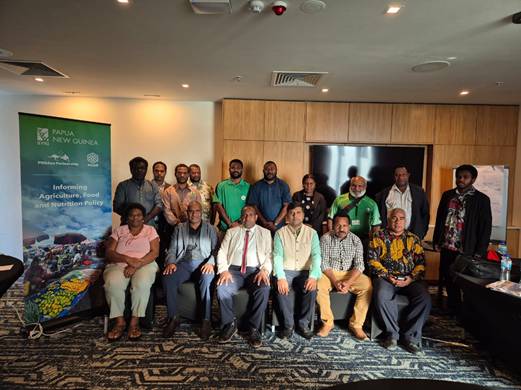
Picture by IFPRI-PNG: Pilot Training