4–8 May 2026
Building on the agriculture sector database compilationtraining, IFPRI and DNPM subsequently conducted a week-long Computable General Equilibrium (CGE) Modelling Training from 4–8 May 2026.
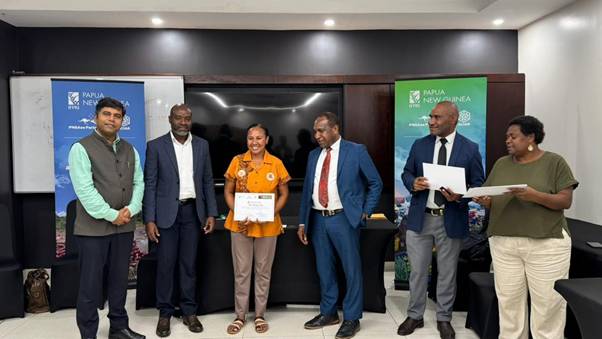
The training brought together returning participants from the pilot session alongside new participants from key government agencies. A total of eighteen participants successfully completed the training and received certification. Participants represented DNPM, DAL, KIK, CBPNG, the Department of Prime Minister and National Executive Council, the National Statistical Office (NSO), the Department of Information and Communication Technology (DICT), and the Department of Commerce and Industry (DCI).
While opening the training, FAS Sanja Papae emphasised the important role the training would play in supporting the PNG Government’s preparation of MTDP V 2027–2032 and strengthening evidence-based policy analysis within government institutions.
The training, facilitated by Barun Deb Pal from IFPRI, introduced participants to the fundamentals of the Social Accounting Matrix (SAM) framework and Computable General Equilibrium (CGE) modelling. Participants received an overview of the SAM framework and its relationship to the circular flow of the economy. As part of the practical exercises, participants developed a Macro SAM using official PNG government data sources, including the National Budget and National Statistical Office databases.
Participants were also introduced to economic multipliers, coefficient matrices, and multiplier scenarios. Hands-on exercises were conducted to simulate the direct, indirect, and economy-wide effects of economic shocks across sectors.
On the fourth day, participants received introductory training in the GAMS software and conducted CGE simulations through group exercises. Participants worked collaboratively to analyse policy scenarios, run simulations, and present findings at the conclusion of the training program. The exercises provided participants with practical analytical and technical skills to support evidence-based planning and economic policy analysis through CGE modelling.
As part of the group exercises and presentations, participants analysed a range of economic and policy scenarios, including:
- A 20 percent reduction in crop productivity;
- A 30 percent increase in world oil, petroleum, and fertiliser prices;
- A 20 percent decline in total factor productivity (TFP) in the electricity sector;
- Doubling government transfers to poor households; and
- Increased capital investment in trade and transport infrastructure under the Connect PNG initiative.
In closing the training, Deputy Secretary Michael Kumung reaffirmed DNPM’s commitment to strengthening its CGE modelling capability with continued support from IFPRI. He emphasised the importance of evidence-based and informed decision-making to ensure that government policies and investment decisions are effectively assessed through economic modelling.
Deputy Secretary Kumung also encouraged junior officers from participating agencies to continue building their technical and analytical capabilities and to actively participate in future CGE modelling and economic analysis training programs offered through the IFPRI-DNPM partnership.
Key Outcomes
The trainings contributed towards strengthening technical capacity in economic data management, growth analysis, SAM development, and CGE modelling across participating government agencies and sector institutions. Participants gained practical experience in economic data analysis, policy simulation, and evidence-based planning approaches relevant to PNG’s national development priorities.
The workshops also strengthened collaboration among government agencies and sector institutions involved in planning, agriculture, statistics, and economic policy analysis, while establishing a stronger foundation for continued CGE modelling and analytical capacity development within DNPM and partner agencies.
Picture by IFPRI-PNG: CGE Modeling Training
Picture by IFPRI-PNG: CGE Modeling Training